 Print
Print
 Add to Favorite
 Share
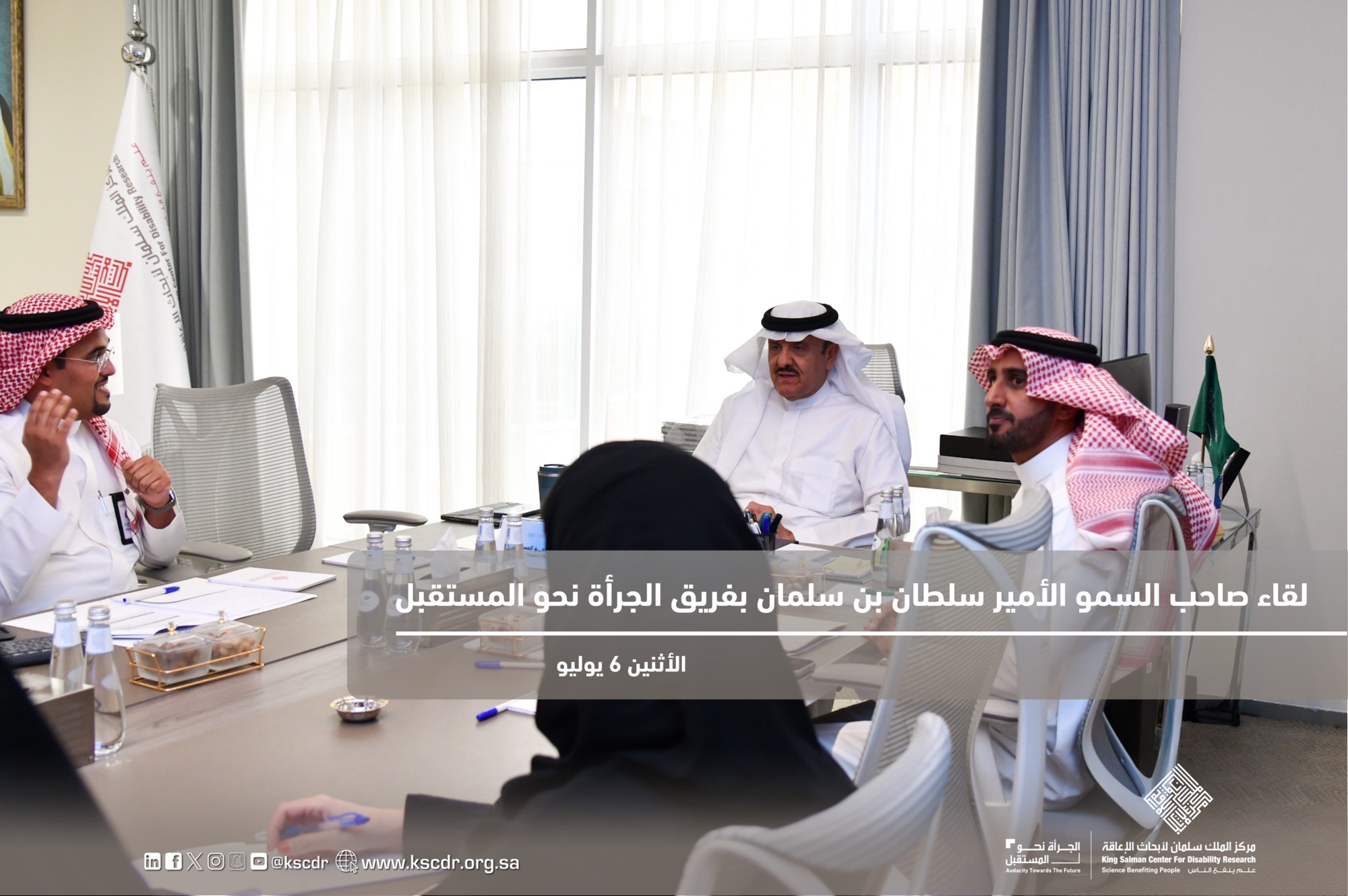
ShareHis Royal Highness Prince Sultan bin Salman bin Abdulaziz, Special Advisor to the Custodian of the Two Holy Mosques and Chairman of the Board of Trustees of the King Salman Center for Disability Research, met with the Audacity Toward the Future Program team to review the program's latest developments, including its Research Award and the progress made in supporting high-impact research in the field of disability.
Program Updates
During the meeting, the team presented an overview of the Audacity Toward the Future Program's objectives, the process for inviting researchers to participate, the methodology used to evaluate submissions, and the outcomes of the scientific review process. The finalists for the Research Award, along with the program's upcoming implementation milestones, were also reviewed.
Advancing High-Impact Scientific Research
The meeting reflects His Royal Highness's commitment to supporting research initiatives with sustainable impact, strengthening scientific partnerships, and attracting outstanding researchers capable of developing innovative solutions to disability-related challenges.
Meeting Attendees
The meeting was attended by Dr. Badr Al-Hajhouj, Chief Executive Officer of the King Salman Center for Disability Research; Dr. Nasser bin Turki, Supervisor of the Audacity Toward the Future Program; Professor Steven Laureys, Chair of the Program's Strategic Team; Professor Swathi Kiran, Vice Chair of the Strategic Team; and Dr. Shireen Al Salmi, Assistant Program Supervisor.
A Strategic Initiative
The Audacity Toward the Future Program is one of the strategic initiatives of the King Salman Center for Disability Research. It aims to promote pioneering research and empower researchers to develop scientific solutions that enhance the quality of life of persons with disabilities.
Research Proposals and Participating Institutions
The Program received outstanding research proposals from leading research teams representing distinguished universities, academic institutions, and specialized disability research centers from around the world. The proposals span a wide range of research areas, including restoring speech and consciousness after stroke, developing brain-computer interfaces for people with paralysis, enabling early detection of motor delays in infants, protecting the brain during the critical stages following traumatic brain injury, and enhancing memory through targeted neurostimulation.